Most of the time, I live in my head. I write, I plan, I think. It is for this reason that I look forward to working with my hands and my body, and why I started brewing coffee, writing letters by hand, and staying fit. I wanted something tangible. It is precisely for this reason that I, for a while now, have wanted to try my hand at pottery. But it was never that strong a desire that I went looking for a pottery workshop.
And then last week, I saw a post from the Kochi Muziris Biennale page on Instagram. A free, three-day pottery workshop at Fort Kochi, led by Mr Jayan VK, a national award-winning master terracotta artist. It was mandatory to attend all three days. So I cleared the dates and registered.
Hesitation on the First Day of the Pottery Workshop
I didn’t want to admit it to myself, but on day one, I was hesitant to put my hand in the clay. Growing up, my mother would never let me play with sand. She was a doctor, and when she said “You will get sick if you play with mud”, I believed her. Which is why it stuck in my head all these 30-plus years and why I was hesitant to put my hands in the mud.
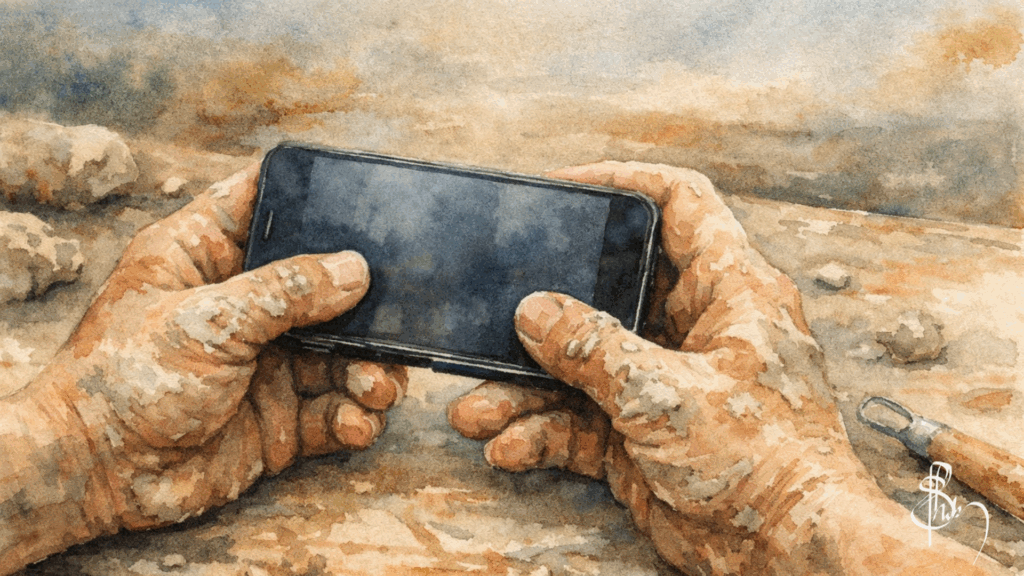
But then I saw the ease with which the master, Mr Jayan, was handling the clay. How his assistant was at ease with it. They were all so comfortable touching their phones, even with mud-dried hands. That made it feel normal. The instructors showed us how to cut pieces from the blocks of clay using a thread, how to pinch the clay, roll and wet it and make it the right consistency to work with.
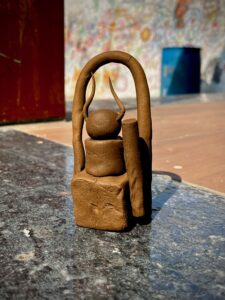
When I finally touched the clay, it was a surprise. The 11 o’clock sun was shining hot outside the tent, but the clay was cold. Not icy cold, but pleasantly cold. It was nice to touch. It was supple, but thick. The first day’s assignment was to create what you felt like. Beyond the basics, there were no more instructions or rules.
The Community That Formed During the Pottery Workshop
I had mixed feelings about the pottery workshop being open to the public. So people kept dropping in for ten or fifteen minutes just to play with clay and leave. Some were just making a lot of fuss and mess. But then there were also people who tried to get some shapes into place with dedication.
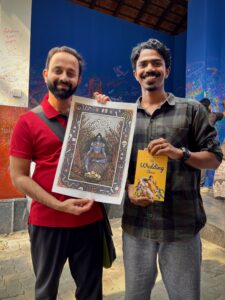
By the second day, those of us who stayed went out for lunch, tea and hung out. There were people in between careers, students, teachers, artists and locals. All with a shared willingness to stay, try and learn.
Breaking and Remaking in Clay
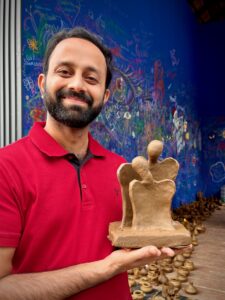
On the second day, our instruction was to start from a reference sculpture of our choosing and make it. I found an image of a modern sculpture on Pinterest. It had two abstract figures sort of hugging each other.
I didn’t even know how to make a proper slab at first. Someone handed me a tool like a chapati rolling cylindrical thing that I used to make the slab. I struggled most with the head. I couldn’t get the shape correct. Arun from Aroor, a friend I made there, helped me shape it. He had gone to clay modelling competitions, so he knew much more than I did. Teachers helped too. In fact, most sculptures were quite team efforts. Advice, tools, and hands moved freely between people. Finally, with help, I somehow made the head and attached it to the rest of the sculpture.
I showed it to the master on the third morning. He wasn’t satisfied with the head. He came, plucked out the head instantly. There I was, in shock at the violence that had just happened right before my eyes. Something I had put so much effort and help into making was plucked off like it was nothing. How could he!
But even before I could raise my voice to protest, he showed me how to make a head properly and reattached the head. And it looked like it had never been broken off. I mean, I was so worried all of that time I might break the heavy head off while I was trying to polish the rest of the sculpture, and he was not even bothered about breaking anything.
Community Sculpture
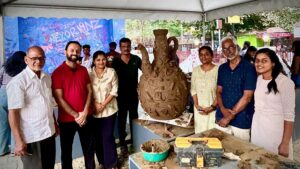
These individual sculptures we were each making were part of the pottery workshop. Beyond these, there was a large pot being built collectively over all three days. It was being built on a turntable. It was tall, maybe four or five feet. We could all contribute a piece that would go on the large pot as long as it was ocean-themed.
People worked on this large community pot from all sides. The master had planned for two handles on either side of the pot. He built these separately and attached them on the third day. But one handle fell off. What surprised me was that Mr Jayan didn’t seem to bother. He just picked up the wet clay handle that fell and attached it again. It fell off again after an hour. And still he seemed unbothered. He just changed the idea of it being a handle to something like a nozzle of a teapot. He attached that, and it stayed.
Impermanence of Working With Clay
That’s when I realised, okay, it’s not about perfection. It’s not about the fear of messing things up. It’s just clay. No matter how perfect you think you have made it or no matter how worried you think you might mess it up, it’s just clay. You mess it up again. You start over. And it’s fine.
That same lesson had hit me the first day itself. From another friend I made at the pottery workshop, who was a ceramic artist, Diya. She had spent hours on the first day shaping a figurine. When finally she wasn’t satisfied, she placed her palm on top of the figurine and flattened it out back into a shapeless lump with one decisive move. How can one do that! Why would one do that! But she said it was okay. That she’ll do it again. It reminded me of the Buddhist monks who make mandalas for days, and blow them away to remind them of impermanence.
The Third Day of the Pottery Workshop
Physically, the days were harder than I expected. We were sitting in direct path to the ocean breeze that kept dehydrating me all through the three days. The first day afterwards, I was completely dehydrated. I had to take a rehydration solution and drink some two litres of water in one go before I was even normal. By the third day, I was sick enough to wonder, briefly, if my mother had been right after all. I couldn’t tell what had caused it.
Tired and with a headache, I went on the third day. I didn’t do much work that day. I tried contributing to the large community pot, the ocean theme one, by building the stern of the Titanic, or at least that was the idea. But I just couldn’t get my head around a way to make it work.
Mostly, I just sat and watched others. Many made fish, seahorses, mermaids and so on. Diya kept building one ocean sculpture after another and handing it over to be attached to the pot, like those class nerds who annoyingly keep asking for additional sheets during exams. I didn’t want to leave. When I registered, I had made a promise to attend all three days. Giving up felt like failure. But more importantly, I in fact liked the space, the community. The vibe.
What Stayed After the 3-Day Pottery Workshop
On the morning of the first day of the workshop, my phone had vibrated in my pocket from some 5 or 8 calls. My hands were full of clay. And I didn’t have it in me to go wash my hands to pick up the phone, only to get them dirty again. Mind you, it takes a full two to three minutes to clean off all the clay from one’s hand. Nor was I going to touch my phone with clay.
So for the first two days of the pottery workshop, I left my phone in my pocket. But surprisingly, by the third day, I found myself taking photos on my phone with my clay-dried hands. And it felt very normal. Perhaps seeing everyone else getting used to doing that by then was what made it normal. Whatever it might have been, that is when I guess I knew I had let go of my initial hesitation. My mother’s warning voice is perhaps fading away.
Sitting home now, resting my body, I don’t feel like I have learned the entirety of pottery. But something may have shifted somewhere. The fear of messing up, of playing, getting dirty and worrying about any of it. Maybe I want to believe that is true. Perhaps it is true, and only time will tell. Even now, there’s still a trace of clay under a fingernail.